


An HVAC contactor is a heavy duty electrical switch that turns your compressor and condenser fan motor on and off every time the thermostat calls for cooling. It looks small and simple. Two terminals on top, two on the bottom, a coil pulling them together. It is also one of the most common failure points in any air conditioner, and the failures show up in the worst possible ways. Welded contacts that never stop running. Burned coils that never start. Chattering that fries everything downstream. Here is what you need to know about the part you almost never think about until it fails.


What a Contactor Actually Does
Your thermostat is a low-voltage device. It runs on 24 volts and milliamps of current. Your compressor and fan motor are high-voltage devices pulling 240 volts and 20 to 40 amps. You cannot run that much power through a thermostat wire without melting it. The contactor solves this by acting as a switching middleman.
When the thermostat calls for cooling, it sends 24 volts to a small electromagnetic coil inside the contactor. That coil energizes and physically pulls a set of contact points together, completing the high-voltage circuit to the compressor and fan motor. When the thermostat is satisfied, it cuts the 24 volts, the coil releases, the contacts spring apart, and everything shuts off. Simple electromechanical relay. Every AC system has at least one. Heat pumps usually have two.
That low-tech simplicity is the whole reason contactors are so reliable, and also the reason they fail in predictable ways. The contacts have to physically slam together and pull apart thousands of times every cooling season. Eventually they pit, burn, weld, or get stuck. The coil that pulls them has to handle thousands of energize-and-release cycles. Eventually the coil burns out.
Single Pole vs Dual Pole Contactors
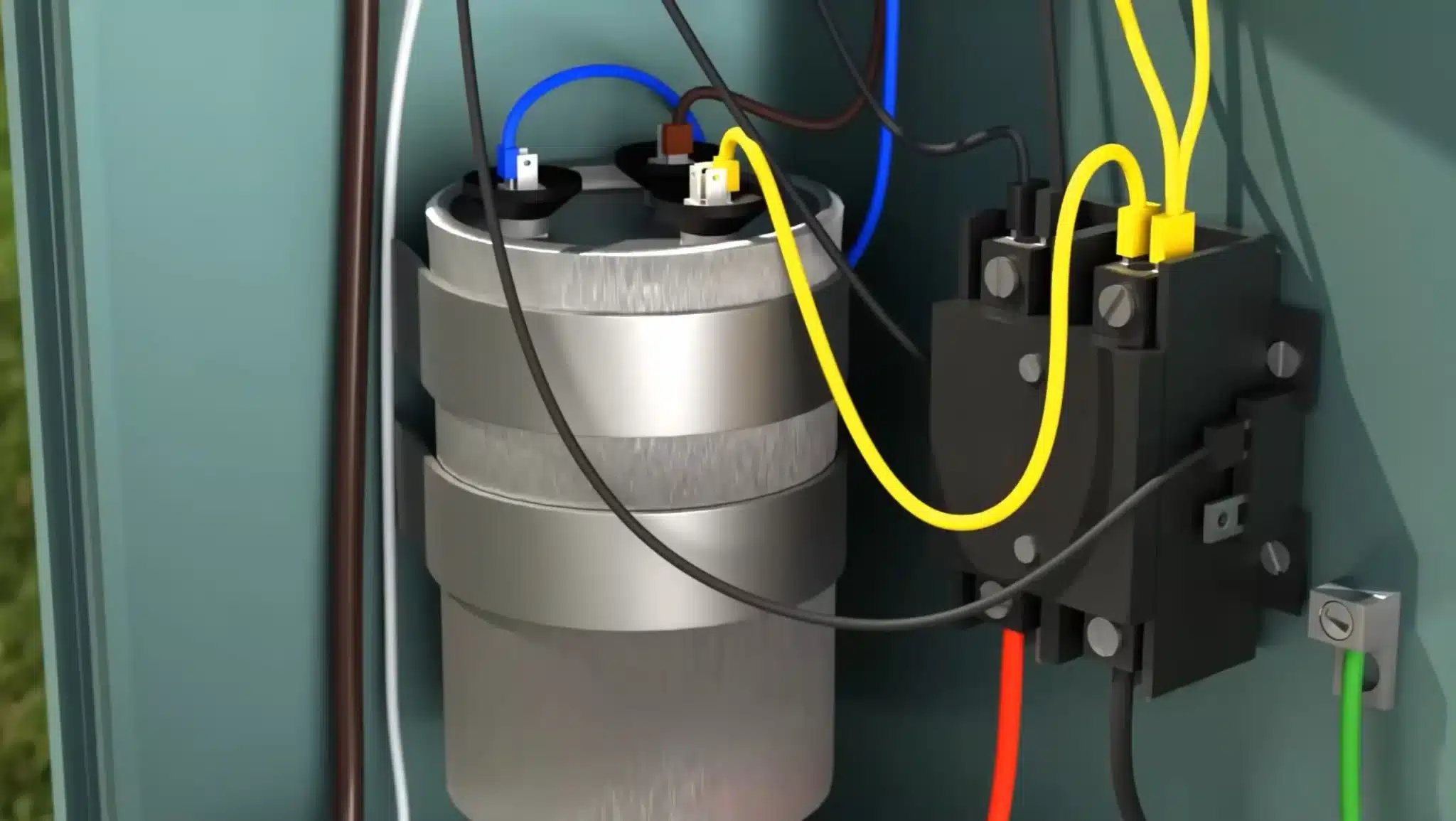
Residential contactors come in two flavors. Single pole contactors switch only one leg of the 240-volt circuit. The other leg stays hot all the time, even when the system is off. This is fine electrically because the compressor will not run with only one hot leg, but it means there is always voltage waiting at the compressor terminals. Single pole contactors are slightly cheaper and the standard on smaller residential systems.
Dual pole (sometimes called double-pole or DP) contactors switch both legs of the 240-volt circuit simultaneously. When the system is off, no voltage is present at the compressor terminals at all. Safer to service. Required by code on some commercial setups. Common on larger residential systems and heat pumps.
When replacing, match the number of poles, the contact amp rating (usually 30 amp or 40 amp on residential), and the coil voltage (24V for almost all residential systems). Wrong pole count or wrong coil voltage and the system either does not run or fries something within a few cycles.
Signs Your Contactor Is Failing
Chattering or buzzing noise from the outdoor unit
If the contactor coil is weak or the control voltage from the thermostat is marginal, the contacts pull in partially, drop out, pull in again, drop out again, dozens of times per second. The result is a loud buzz or chatter from inside the outdoor unit. Each one of those make-and-break cycles arcs across the contacts, accelerating pitting and burning. A chattering contactor will be totally dead within days.
System will not shut off, runs continuously
Welded contacts. After enough arcing, the contact points physically fuse together. The thermostat tells the contactor to release, but the welded points stay closed. The compressor and fan motor keep running until you cut power at the disconnect. This is a real danger because the compressor can overheat and the indoor coil can freeze solid if left running long enough.
Outdoor unit completely silent on a call for cooling
Burned out coil. The contactor no longer has the electromagnetic pull needed to close the contacts. Thermostat calls for cooling, no response, dead silence at the outdoor unit. If the contactor is the failure, you should see no movement at all when you watch the contacts during a call. If you hear or feel the contactor try to pull in but it does not seat, the coil is weak rather than completely dead.
Burn marks, melted plastic, or insect debris in the contactor
Open the access panel and look at the contactor. Healthy ones look clean. Failing ones often show charred spots near the contacts, melted plastic on the housing, or, surprisingly often, dead bugs that crawled in and shorted across the contacts. Wasps and earwigs love HVAC equipment. They are also one of the leading causes of contactor failure in South Bay outdoor units, especially in spring and fall.
Why Contactors Fail So Often in the South Bay

Contactors die for four main reasons in this climate.
One. Heat and humidity. Even though the South Bay is dry compared to the East Coast, summer thunderstorm activity in Morgan Hill and Almaden brings humidity spikes. Heat plus humidity plus electrical arcing equals accelerated contact wear. Contactors in shaded units last years longer than ones baking in direct afternoon sun.
Two. Insects. This sounds funny until you have replaced as many bug-killed contactors as we have. Earwigs and wasps crawl into the outdoor unit, settle on the contactor, and either short the coil to the case or wedge themselves between the contacts. The result is either a burned coil or contacts that cannot close cleanly. Spring tune-ups should always include checking inside the contactor for insect activity.
Three. Failed capacitors stressing the contactor. When a capacitor weakens, the motors it serves draw locked rotor amperage on every start. That surge passes through the contactor contacts. Each surge pits them a little more. Replace the capacitor when it goes weak and the contactor lasts years longer.
Four. Low control voltage. If the 24 volt supply from the indoor transformer is weak (degraded transformer, long thermostat wire run, voltage drop), the contactor coil cannot pull in cleanly. Chattering starts, contacts arc, contactor dies. Measure control voltage at the contactor coil, not just at the thermostat, to catch this.
Should You Replace a Contactor Yourself?

Contactor replacement is one of the more DIY-accessible HVAC repairs IF you take the electrical hazards seriously. The contactor is sitting in a cabinet carrying 240 volts AC. Get casual with that and the consequences are severe.
If you are doing it anyway, kill power at the disconnect AND the main breaker. Wait five minutes. Verify zero voltage at the contactor terminals with a multimeter before touching anything. Take a photo of the wiring before you remove a single wire. Match the new contactor on poles, amp rating, and coil voltage. Transfer one wire at a time from old to new. Tighten terminals firmly but do not strip the screws. Power up, watch the contacts pull in cleanly on a call for cooling, verify amp draw on the line side is normal.
Pro replacement runs 200 to 400 dollars in San Jose. Part cost is 25 to 60 dollars. Most of the bill is the diagnostic, the safe disconnection, the warranty, and not having to come back when something else turns out to be the real problem. For most homeowners the math works out fine, especially since contactor failure usually points at related issues (capacitor, control voltage, insect intrusion) that a real diagnostic catches in the same visit.
Frequently Asked Questions About HVAC Contactors
How long should an HVAC contactor last?
5 to 10 years is normal in South Bay conditions. We see units in shaded installs make 12 to 15 years. We see units exposed to insects and full sun fail in 3 to 5. A spring tune-up that includes checking the contactor adds years to the average.
How much does contactor replacement cost in San Jose?
Total job runs 200 to 400 dollars including diagnostic, the new contactor, labor, and verification. Emergency or after-hours service costs more. The part alone is 25 to 60 dollars but the diagnostic is what keeps you from replacing a contactor that was being killed by a different upstream problem.
Can I keep using my AC if the contactor is chattering?
No. Chattering accelerates every other failure in the system. The capacitor takes a beating, the compressor windings take a beating, the contactor itself is days from welding shut or burning open. Shut it off and have it diagnosed before you turn it back on. A 25 dollar part now beats a compressor next week.
Why did my contactor burn out a month after replacement?
Three usual suspects. Wrong-rated replacement part, low control voltage from a degraded transformer, or a weak capacitor stressing the contactor on every start. All three are diagnostic failures, not part failures. The replacement contactor will keep dying until the upstream cause is fixed.
Do mini splits have contactors?
Inverter-driven mini splits do not use a traditional electromechanical contactor. The control board uses solid-state switching to ramp the compressor up and down. Failures look different and cannot be diagnosed with the same techniques. If a mini split outdoor unit will not start, the troubleshooting path goes straight to the control board, not to a relay.
AC Buzzing, Chattering, or Refusing to Start? Get the Diagnostic Done Right
Silicon Valley Comfort diagnoses contactor and electrical failures across Santa Clara and San Mateo counties. Call 408-691-5940 or email service@air.systems. We measure first, find the actual cause, replace the right part the first time.
Related HVAC Services
- AC repair in San Jose
- emergency HVAC repair
- refrigeration circuit components
- HVAC service areas across the South Bay
Need this handled instead of DIY? Silicon Valley Comfort runs same-day calls across the South Bay. Call 408-691-5940 or book a visit with Silicon Valley Comfort.